Writing Review
Food Review in Pakistan (2026 Guide): How to Write Restaurant Reviews + Examples
⏱️ 8 min read•March 31, 2026
Read More →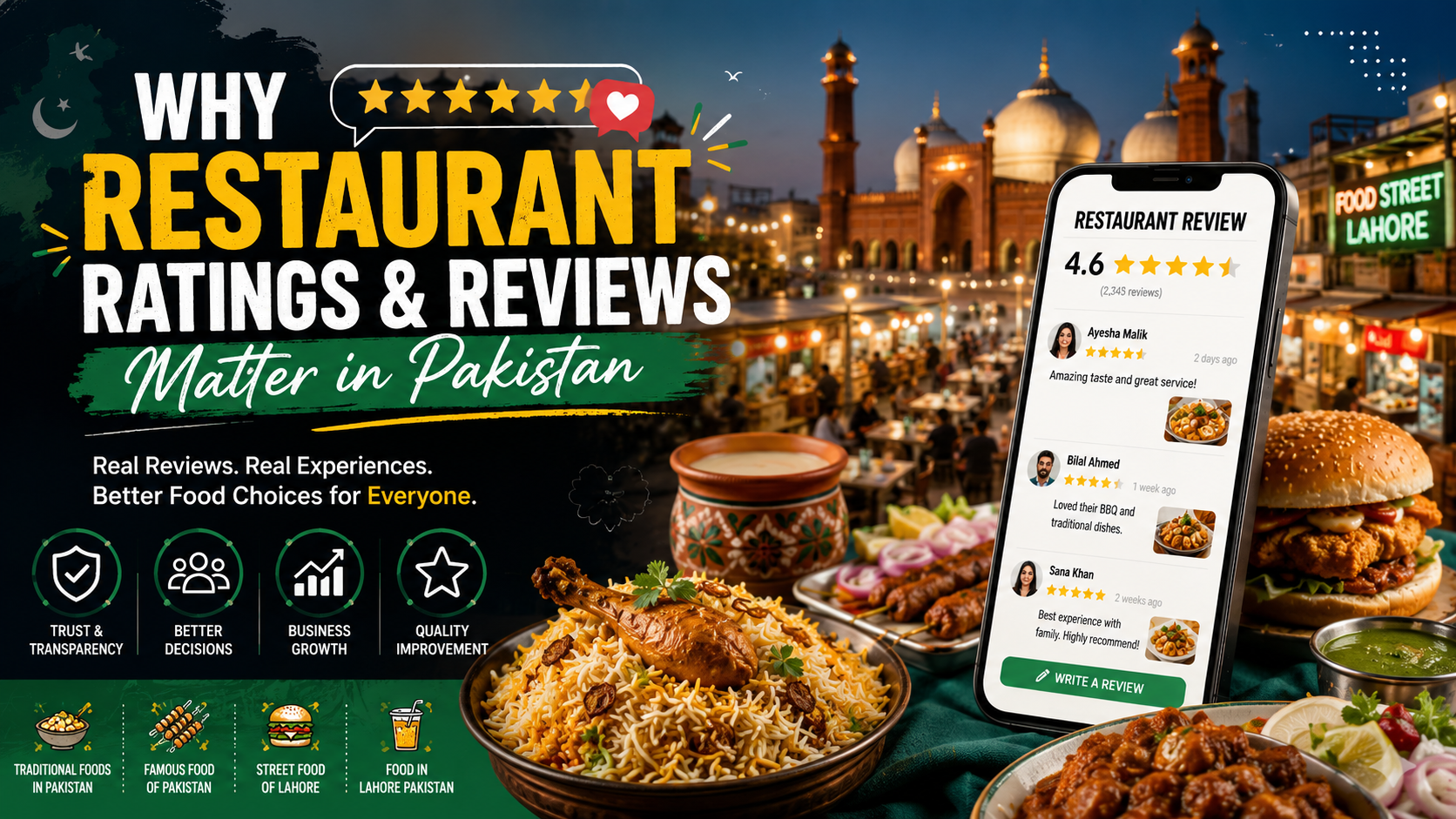
In Pakistan, most customers don’t choose a restaurant by menu first — they choose it by rating first.
A restaurant with great food but weak reviews often loses customers to a competitor with stronger ratings.
This blog explains why ratings and reviews matter so much, how they affect Google rankings, and how Pakistani restaurants can consistently get more reviews and build a strong online reputation in 2026.
Picture this. You have just opened a new restaurant in Lahore. The decor is warm, the biryani smells incredible from the street, and your staff has been trained well. But the tables stay empty for the first few weeks.
For many restaurant owners in Pakistan, this is not just a story — it is a reality they face right now. And more often than not, the reason has nothing to do with the quality of the food.
It has everything to do with what strangers see — or do not see — when they search for your restaurant online.
Today’s Pakistani diner almost always checks ratings and reviews before making a decision. The phone comes out, a quick search happens, and within thirty seconds a first impression is formed.
★ KEY INSIGHT A weak or empty review profile sends people scrolling to the next option. A strong one — even a modest 4.3 stars with fifty genuine reviews — builds the kind of trust that brings people through your door.
This guide is for anyone in the food business who wants to understand why that digital reputation matters, and how to build one that works. For a broader introduction, explore the Rabaat food review guide for Pakistani food lovers — a great starting point for understanding how Pakistanis discover and rate restaurants today.
The relationship between customer reviews and restaurant success is not just anecdotal. Global research paints a clear picture.
| 93% | of consumers say online reviews affect their dining decisions (BrightLocal). Missing reviews = missing customers. |
| 88% | of diners trust online reviews as much as a personal recommendation from a friend. |
| +31% | more revenue earned by restaurants with 4+ star ratings. Higher rating = more walk-ins and bookings. |
| 5–9% | revenue increase per single star improvement, per Harvard Business School research. |
| 57% | of people will not visit a restaurant with fewer than 4 stars — even if the food is excellent. |
Pakistan’s food industry is growing fast. Platforms like Google Maps, Foodpanda, Zomato, and Rabaat have become genuine discovery tools for millions of diners. To understand which platforms matter most for visibility, see this breakdown of the top 7 food review websites in 2026.
When someone lands on your Google Business profile and sees four hundred reviews with an average of 4.6 stars, something happens psychologically. They feel reassured. This is social proof — one of the most powerful forces in human decision-making.
A strong rating profile tells first-time visitors that real people enjoyed their time here and that they are unlikely to be disappointed. In a market where trust is hard to earn and easy to lose, that matters enormously.
No advertising campaign is as persuasive as a genuine five-star review written by a real customer. When someone writes that the seekh kebabs were the best they have had all year, that sentence does marketing work that no paid ad can replicate. And it costs you nothing.
2026 UPDATE: AI SEARCH AI-powered tools like ChatGPT, Google’s Gemini, and AI Overviews now pull review data directly into their answers. When someone asks ‘which restaurant in Islamabad is good for a family dinner,’ these tools analyse your reviews to decide whether to recommend you. More genuine reviews = more chances of appearing in AI-generated answers.
Google’s local search algorithm weighs review count, average star rating, recency, and how frequently the owner responds. If a competitor has 300 reviews and you have 20, they will outrank you for searches like ‘restaurants near me’ or ‘dinner in DHA Lahore’ regardless of food quality.
A profile with nothing but five-star ratings reads as suspicious. Some degree of mixed feedback, honestly dealt with, signals authenticity. A calm, professional response that acknowledges a problem and offers a resolution shows that you care about the experience beyond just taking someone’s money.
REAL EXAMPLE A Lahore café received a widely-shared complaint about slow service. The owner responded publicly within hours, acknowledged the wait, and invited the customer back. That response was shared over a thousand times. The following week, the café was busier than it had ever been.
When three separate reviews in one week mention that the naan arrived cold, that is a kitchen process problem worth addressing. When five reviews praise your gulab jamun, put it front and centre on your menu. Reviews hand you operational intelligence for free — make it a weekly habit to read your ten most recent across all platforms.
A single review today does not transform your business. But fifty reviews over six months, consistently positive and thoughtfully responded to, create a compounding effect: rating strengthens, ranking improves, new customers find you, they leave reviews, and the cycle continues.
Google heavily weights how recently a review was posted. A restaurant with 200 reviews but none in the past six months will rank lower than one with 80 fresh reviews from the last few weeks. Getting reviews is not a one-time campaign — it is an ongoing operational habit.
On Foodpanda, Zomato, and food discovery platforms, a higher rating directly impacts where you appear in search and browsing results. Higher placement means more eyeballs, more clicks, and more orders — without additional ad spend.
| Factor | With Active Reviews | Without Reviews |
|---|---|
| Google Search Visibility | High — appears in local map pack | Low — rarely surfaces |
| Customer Trust | Strong — social proof converts | Weak — uncertainty drives people away |
| New Customer Acquisition | Organic and steady | Requires heavy paid advertising |
| Feedback & Improvement | Continuous, free, direct | Guesswork with no real data |
| AI Search Recommendations | Likely recommended by ChatGPT, Gemini | Rarely surfaces |
| Brand Credibility | Strong and consistent | Fragile and easily damaged |
| Revenue Impact | Up to +31% from 4+ star ratings | Revenue lost to better-rated rivals |
Knowing that reviews matter is one thing. Actually getting them consistently is another. Here are eight approaches that work.
Around 70 percent of customers will leave a review if asked. Most simply do not think to do it unprompted. Train your front-of-house team to mention it naturally after a positive interaction. Place small cards on tables with a QR code linking directly to your Google review page.
Listing on a platform built for Pakistan’s food scene connects you with an audience actively searching for where to eat. When customers redeem deals through a platform, the natural next step is leaving feedback. Become a restaurant partner on Rabaat to access a growing base of food lovers and start building your verified review profile — it is one of the most straightforward ways to grow digital visibility in Pakistan right now.
When you respond to a positive review, the customer feels appreciated and is more likely to return. When you respond to a negative one thoughtfully, you demonstrate professionalism to every future reader. Google also takes response rate into account when ranking local businesses. Aim to respond within 24 hours. Keep it warm, specific, and genuine.
Pakistan’s food scene on Instagram, Facebook, and TikTok is vibrant and growing fast. When customers tag your restaurant in a post, reshare it and nudge them toward leaving a formal review. For content ideas and dining trends, the Rabaat food blog regularly covers what is resonating with Pakistani food lovers right now.
Reviews flow more easily from memorable experiences. If something delights a customer — an unexpectedly beautiful presentation, a thoughtful gesture from staff, an Instagram-worthy corner of the restaurant — they are far more likely to share it. Build those moments deliberately into your operations.
• Ramadan Iftaar and Sehri promotions draw large groups who will share the experience online.
• Family deal nights on Fridays tap into the culture of group dining.
• A rooftop BBQ evening in Karachi or live music in Lahore can generate more reviews in one night than months of passive waiting.
• Inviting food bloggers or photographers to a tasting evening generates content and reviews simultaneously.
Most Pakistanis prefer WhatsApp over phone calls or email. After a reservation or delivery, a friendly WhatsApp message thanking the customer and providing a direct link to leave a review converts at a significantly higher rate than automated email campaigns. Keep it brief and warm — never chase more than once.
The easiest first step is getting your restaurant listed where Pakistan’s food lovers are already searching. Register your restaurant on Rabaat for free — once listed, customers who discover and visit you are naturally prompted to share their experience, starting your review cycle automatically.
Pakistan’s restaurant industry is in the middle of a genuine boom. New cafés, fine dining spots, regional cuisine restaurants, and modern dhabas are opening across every major city. Competition has never been higher.
At the same time, Pakistani consumers are more connected than ever. Smartphone penetration is rising, mobile data is affordable, and food discovery platforms have become genuine gatekeepers of dining decisions. When a family in Islamabad is deciding where to go for dinner on Saturday, the conversation often starts with someone pulling up Google Maps or a food discovery app.
Understanding what drives dining decisions in Pakistan starts with the food itself. The guide on famous food of Pakistan reflects exactly the kind of cuisine that earns the strongest review engagement from food lovers across the country — from karahi and biryani to nihari and mithai.
COMPETITIVE REALITY 2026 The restaurants winning in Pakistan’s food market are not those with the biggest budgets. They are the ones that have figured out how to be visible, credible, and trusted online — and reviews are the single most important ingredient in all three.
| Promotion Idea | Why It Works & Review Potential |
|---|---|
| Fixed-price lunch combos | Office workers and families love predictable value — and predictability earns reviews. |
| Loyalty punch cards | Repeat visits create repeat reviewers. The 10th meal free is a classic motivator. |
| WhatsApp reservation & follow-up | A follow-up with a review link converts well in a WhatsApp-first culture. |
| Family platter deals | Group dining is a cultural staple — one table can generate multiple reviews. |
| Ramadan Sehri & Iftaar specials | Huge seasonal demand; emotional atmosphere makes people want to share the experience. |
| Birthday perks or free desserts | Creates shareable moments and emotional loyalty — a high review-trigger occasion. |
| Rooftop BBQ or seasonal events | Summer evenings in Lahore/Karachi drive walk-ins and social sharing. |
| Food blogger tasting events | Generates authentic content, trusted reviews, and social reach simultaneously. |
The most reliable method is the simplest: ask. Train your team to mention reviews after a positive meal. Add QR codes to tables. List your restaurant on Google Business and food discovery platforms, where satisfied customers are naturally prompted to leave feedback. And create experiences worth writing about.
Yes, ideally. Google is the most important for search visibility. Food discovery platforms matter for reaching Pakistani food lovers specifically. Zomato and Foodpanda are valuable if you offer delivery. Each platform gives you an additional channel. A presence across two or three relevant platforms is much stronger than a single-platform strategy.
Respond promptly and professionally, without being defensive. Acknowledge the issue, apologise genuinely, and offer to resolve it privately. Future customers read your responses as closely as the reviews themselves. A thoughtful reply to criticism often builds more trust than a dozen five-star ratings ever could.
Short-term, possibly. Long-term, they can permanently damage your business. Google and most platforms have sophisticated algorithms to detect fake reviews and will penalise or delist your profile. Genuine reviews, earned over time, are far more valuable and sustainable.
Google’s local algorithm weighs review quantity, rating score, and how recently reviews were posted when deciding which restaurants appear in the local map pack. More consistent, high-quality reviews generally translate to better visibility for searches like ‘best biryani in Lahore’ or ‘restaurants near me.’
Post consistently, not just when you have something to promote. Share behind-the-scenes content — the kitchen at work, the story of a signature dish, the team that makes things happen. Use local food hashtags relevant to your city. Engage genuinely with comments and shares. And always link your review page in your bio.
The following is structured for Google’s featured snippet (position zero) and AI-powered search engines that summarise answers directly from content.
Restaurant ratings and customer reviews are among the most powerful growth tools available to any food business. Here is why:
• 93% of people check reviews before dining out — missing reviews means missing customers.
• They improve Google local search visibility, meaning more people discover you organically.
• Every positive review is free, credible marketing that no paid ad can replicate.
• They give you continuous, free feedback on what is working and what needs to change.
• AI-powered tools like ChatGPT and Google’s AI Overviews recommend restaurants based on review data.
• A single star increase in your average rating can translate to a 5–9% revenue increase (Harvard Business School).
• In Pakistan, Google Maps and food discovery platforms are the first places food lovers look when deciding where to eat.
• A strong review profile is not optional — it is the baseline for sustainable restaurant growth in 2026.
| Question | Answer |
|---|---|
| Why do restaurant reviews matter so much today? | Because your potential customers check your ratings before they step through your door. 93% of diners consult reviews before choosing a restaurant, and AI-powered search tools now surface review data directly in their answers. |
| How many reviews does a restaurant need to be taken seriously? | Aim for 50+ reviews with a rating above 4.0. Recency matters too — a restaurant with 200 old reviews will rank lower than one with 80 fresh recent ones. |
| How should I handle a negative review? | Respond promptly and professionally. Acknowledge the issue, apologise genuinely, and offer to resolve it privately. Future customers read your responses as closely as the reviews themselves. |
| Is it okay to ask customers to leave a review? | Absolutely — and you should. Around 70% of customers will leave a review if asked. Train staff to mention it naturally, and place QR code table cards linking to your review page. |
| Do fake or paid reviews actually work? | Short-term, possibly. Long-term, they permanently damage your business. Google’s algorithms detect fake reviews and will penalise or delist your profile. |
| How do reviews affect Google search rankings? | Google’s local algorithm weighs review quantity, rating score, and recency when deciding which restaurants appear in the local map pack. |
| How do I get more customers without spending a lot on advertising? | Focus on Google My Business, social media, and food discovery platforms. Consistent posting, responding to reviews, running occasional promotions, and creating experiences worth talking about will organically grow your customer base. |
Here is the honest reality: your restaurant’s online reputation is already forming. Customers are already searching for you, or failing to find you. They are forming opinions based on what they see — or do not see — when they look you up.
Managing your ratings and reviews does not require an expensive team or a complicated strategy. It requires consistency: asking for feedback, responding thoughtfully, keeping your listings fresh, and creating dining experiences that give people something worth sharing.
YOUR MOVE The restaurants that invest in this now — even modestly, even slowly — will be in a dramatically stronger position than their competitors in twelve months. The ones that ignore it will find themselves increasingly invisible in a market that decides where to eat from a four-inch screen.
If you are ready to take the first step, register your restaurant for free and start building the kind of digital reputation that brings customers to you.
Faizan Mustafa
Content Contributor at Rabaat | Based in Pakistan
Faizan Mustafa is an SEO strategist and food content writer based in Pakistan. He contributes to Rabaat — covering Pakistani food, restaurant reviews, and lifestyle guides with an SEO-first approach. Follow his work at rabaat.com
Connect on LinkedIn:
linkedin.com/in/faizanseoexpert--outreachmaster
Google Play Store
Download Rabaat AppPost food photos on Rabaat and earn reward points redeemable at 500+ restaurants across Pakistan.
Looking for the best restaurants in Pakistan?
Explore our complete guide with ratings, reviews, and hidden gems.